
Crafting Cairns
Stones, Surrender, and the Search for the Divine (Restoration Practice #10)

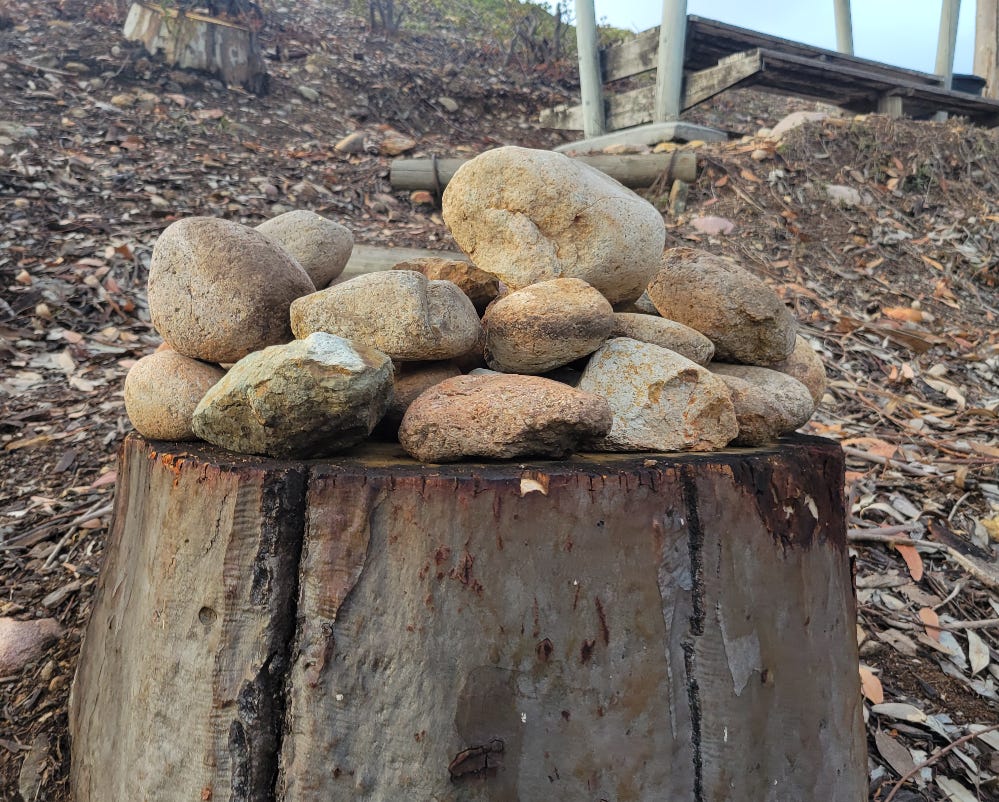
I passed a tree stump covered in stones as I hiked. My first thought was immediate: Oh, it’s a monument! An edifice! I wonder what it means?
Immediately I started to count. Are there twelve stones in this pile? Or did they symbolize prayer requests stacked one on top of another?
Then I realized this could be nothing more than someone absentmindedly placing rocks during a conversation. Or a mindfulness stone stack, collapsed over time. Did growing up in evangelical Christianity train me to assume every stack of stones means something?
Either way, to me, it felt like a statement. It was a signifier, this cairn.1
Meaning From Stones
Last week, on my other Substack, The Table - Average Advocate, we discussed stone monuments fallible humans use to declare themselves godlike.2 But long before that, stone monuments were a way of reaching toward the divine. Across the globe, the earliest peoples—from Celtic to Pacific Islander, from Egyptian to Mesoamerican—used stone markers to proclaim spiritual meaning.
I can’t speak to most of these traditions, but I don’t believe all of these attempts fell short.
The story of my faith is, in many ways, a story of stones. Although Abraham and Isaac, the patriarchs of the Judeo-Christian faith, had their own experiences with stones, I am most drawn to the imagery surrounding Jacob.
The House of God
Jacob, later named Israel, set up his stone pillow at Bethel after dreaming of a staircase between heaven and earth. It symbolized that God was still present, he was still invested in humanity. The stone became a marker: God met me here.
Later, when the Israelites crossed the Jordan into the promised land, they gathered stones from the riverbed and built a memorial. This is where the idea of the twelve stones comes from—one for each tribe. It was meant to stand the test of time, a reminder to future generations and a declaration of what God had done.
Stones appear as witnesses later, too, in the stories of Moses and Samuel. Again and again, they became reminders of divine encounters, moments when heaven touched earth.
Then, in the New Testament—what Christians call the New Covenant—the imagery shifts.
Now Jesus is called the cornerstone, the foundation everything else is built upon. And the people of God are described as living stones, crafted together into a dwelling place for God.
What was once a single marked place—Bethel, the “house of God”—is no longer a location. It is a people. It is us.
You could almost say we are God’s cairn, lovingly designed.

Crafting Cairns: Restoration Practice #10
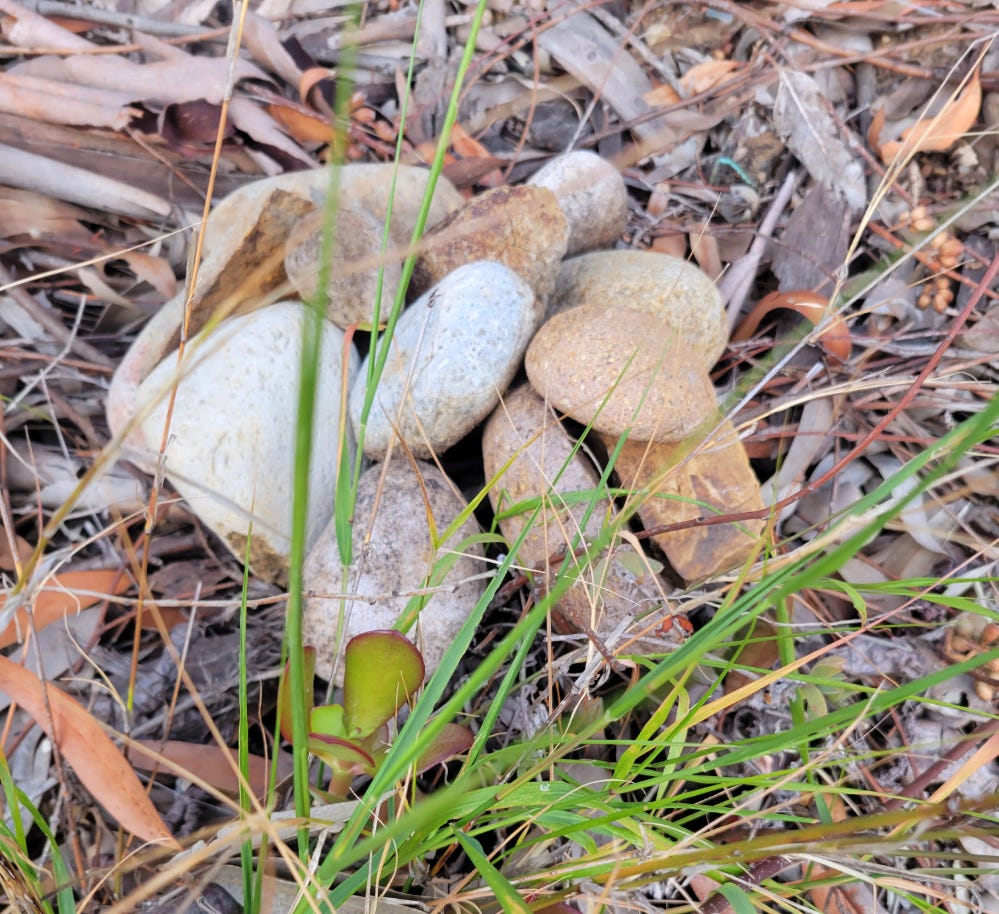
I, too, am haphazardly making a cairn. And I hope you construct one, too.
As I continued hiking beyond the pile of stones on the stump, through the eucalyptus grove, and up the hill overlooking my town and the ocean, I carried a set of metaphorical stones burdening my heart that I needed to lay down.
Restoration Practices are sent out twice a month to invested subscribers, empowering me to continue doing this work of writing. Paid subscribers can continue reading below.
